Wednesday, August 23, 2017


Thursday, August 10, 2017
Professional Photography using Deep Learning
ABSTRACT: Retrieving photography ideas corresponding to a given location facilitates the usage of smart cameras, where there is a high interest among amateurs and enthusiasts to take astonishing photos at anytime and in any location. Existing research captures some aesthetic techniques such as the rule of thirds, triangle, and perspective-ness, and retrieves useful feedbacks based on one technique. However, they are restricted to a particular technique and the retrieved results have room to improve as they can be limited to the quality of the query. There is a lack of a holistic framework to capture important aspects of a given scene and give a novice photographer informative feedback to take a better shot in his/her photography adventure. This work proposes an intelligent framework of portrait composition using our deep-learned models and image retrieval methods. A highly-rated web-crawled portrait dataset is exploited for retrieval purposes. Our framework detects and extracts ingredients of a given scene representing as a correlated hierarchical model. It then matches extracted semantics with the dataset of aesthetically composed photos to investigate a ranked list of photography ideas, and gradually optimizes the human pose and other artistic aspects of the composed scene supposed to be captured. The conducted user study demonstrates that our approach is more helpful than the other constructed feedback retrieval systems.
Art, Computer Vision, Conference Paper, Deep Learning, Image Processing, Machine Learning, Pattern Recognition, Photography, Research, Thesis ACM Multimedia, ACMM, Aesthetics, AI, Art Theory, Artificial Intelligence, CBIR, Computer Vision, Content-based Image Retrieval, Deep Learning, Deep-Learned Model Transfer, Human Pose, Human Pose Estimation, Image Aesthetics, Image Processing, Image Retrieval, Intelligent Portrait Composition Assistance, IPCA, Machine Learning, Object Detection, Pattern Recognition, Penn State Deep Learning, Photography, Photography Idea, Portrait, Portrait Composition, Portrait Dataset, Portrait Photography, Pose Estimation, Pose Recommendation, Scene Parsing, Step-by-Step-Guide on .
Sunday, July 30, 2017
A Public Key Encryption Algorithm for Network Security
Enhanced Public Key Encryption Algorithm for Security of Network
Abstract -- Network security has become more important to personal computer users, organizations, and the military. With the advent of the internet,
security became a major concern and the history of security allows a better understanding of the emergence of security technology. The internet
structure itself allowed for many security threats to occur. When the architecture of the internet is modified it can reduce the possible attacks that can be
sent across the network. Knowing the attack methods, allows for the appropriate security to emerge. By means of firewalls and encryption mechanisms
many businesses secure themselves from the internet. The businesses create an "intranet" to remain connected to the internet but secured from
possible threats. Data integrity is quite a issue in security and to maintain that integrity we tends to improve as to provides the better encryption
processes for security. In our proposed work we will make encryption harder with enhanced public key encryption protocol for security and will discuss
the applications for proposed work. We will enhance the hardness in security by improving the Diffie-Hellman encryption algorithm by making changes or
adding some more security codes in current algorithm.
REFERENCES
[1] Farhat, Farshid, Somayeh Salimi, and Ahmad Salahi. "Private
Identification, Authentication and Key Agreement Protocol with
Security Mode Setup." IACR Cryptology ePrint Archive 2011.
[2] Emmanuel Bresson, Olivier Chevassut, David
Pointcheva, Jean-Jacques Quisquater, "Authenticated
Group Diffie-Hellman Key Exchange", Computer and
Communication Security- proc of ACM CSS'01,
Philadelphia, Pennsylvania, USA, Pages 255-264, ACM Press,
November 5-8, 2001.
[3] Mario Cagaljm, Srdjan Capkun and Jean-Pierre
Hubaux," Key agreement in peer-to-peer wireless
networks", Ecole Polytechnique F´ed´erale de Lausanne
(EPFL), CH-1015 Lausanne.
[4] Michel Abdalla, Mihir Bellare, Phillip Rogaway,"
DHIES: An encryption scheme based on the Diffie-Hellman
Problem", September 18, 2001.
[5] Jean-Fran¸cois Raymond, Anton Stiglic," Security Issues
in the Diffie-Hellman Key Agreement Protocol".
[6] Whitfield Diffie and Martin E. Hellman," New Directions
in Cryptography", invited paper.
[7] F. Lynn Mcnulty," Encryption's importance to
economic and infrastructure security" in 2002.
[8] Tony Chung and Utz Roedig," Poster Abstract: DHBKEY -A Diffie-Hellman Key Distribution Protocol for
Wireless Sensor Networks", Infolab21, Lancaster University,
UK.
[9] A. Chandrasekar, V.R. Rajasekar, V. Vasudevan,"
Improved Authentication and Key Agreement Protocol
Using Elliptic Curve Cryptography" in 2006.
[10] SANS Institute Info Sec Reading Room," A Review of
the Diffie-Hellman Algorithm and its use in Secure
Internet Protocols".
*11+ Paul C. Kocher, "Timing Attacks on Implementations of
Diffie-Hellman, RSA, DSS, and Other Systems", Cryptography
Research, Inc. 607 Market Street, 5th Floor, San Francisco, CA
94105, USA.
[12] Brita Vesterås," Analysis of Key Agreement Protocols",
Mtech Thesis, Department of Computer Science and Media
Technology, Gjovik University College, 2006
[13] (2006) The YouTube website [online]. Available:
[14] (2008) The YouTube website [online]. Available:
[15] (2011) The Wikipedia website [online]. Available:
[16] (2009) The Wikipedia website [online]. Available:
xchange.
Saturday, July 15, 2017
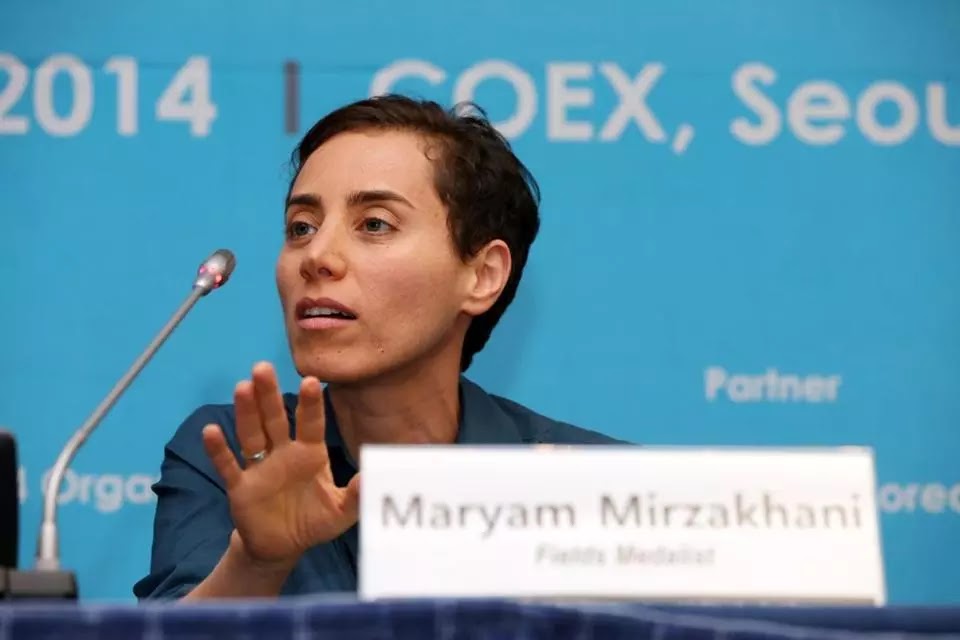
Mirzakhani, Maryam
Maryam Mirzakhani was first women to win Fields Medal in math also professor at Stanford university.




Monday, July 10, 2017
Deep Learning at Pennsylvania State University
Integrating Deep-learned Models and Photography Idea Retrieval
Intelligent Portrait Composition Assistance (IPCA) – Integrating Deep-learned Models and Photography Idea Retrieval, Farshid Farhat, Mohammad Kamani, Sahil Mishra, James Wang, ACM Multimedia 2017, Mountain View, CA, USA.
ABSTRACT: Retrieving photography ideas corresponding to a given location facilitates the usage of smart cameras, where there is a high interest among amateurs and enthusiasts to take astonishing photos at anytime and in any location. Existing research captures some aesthetic techniques such as the rule of thirds, triangle, and perspectiveness, and retrieves useful feedbacks based on one technique. However, they are restricted to a particular technique and the retrieved results have room to improve as they can be limited to the quality of the query. There is a lack of a holistic framework to capture important aspects of a given scene and give a novice photographer informative feedback to take a better shot in his/her photography adventure. This work proposes an intelligent framework of portrait composition using our deep-learned models and image retrieval methods. A highly-rated web-crawled portrait dataset is exploited for retrieval purposes. Our framework detects and extracts ingredients of a given scene representing as a correlated hierarchical model. It then matches extracted semantics with the dataset of aesthetically composed photos to investigate a ranked list of photography ideas, and gradually optimizes the human pose and other artistic aspects of the composed scene supposed to be captured. The conducted user study demonstrates that our approach is more helpful than the other constructed feedback retrieval systems.
Art, Computer Vision, Conference Paper, Deep Learning, Image Processing, Machine Learning, Pattern Recognition, Photography, Research, Thesis and tagged ACM Multimedia, ACMM, Aesthetics, AI, Art Theory, Artificial Intelligence, CBIR, Computer Vision, Content-based Image Retrieval, DEEP LEARNING, Deep-Learned Model Transfer, Human Pose, Human Pose Estimation, Image Aesthetics, Image Processing, Image Retrieval, Intelligent Portrait Composition Assistance, IPCA, Machine Learning, Object Detection, Pattern Recognition, Penn State Deep Learning, Photography, Photography Idea, Portrait, Portrait Composition, Portrait Dataset, Portrait Photography, Pose Estimation, Pose Recommendation, Scene Parsing
Tuesday, May 12, 2015
Detecting Dominant Vanishing Points in Natural Scenes
Academic Endeavors at Pennsylvania State University
- Leveraging big visual data to predict severe weather conditions
- Discovering Triangles in Portraits for Supporting Photographic Creation
- Skeleton Matching with Applications in Severe Weather Detection
- Detecting Dominant Vanishing Points in Natural Scenes with Application to Composition-Sensitive Image Retrieval
- Shape matching using skeleton context for automated bow echo detection
- Detecting Vanishing Points in Natural Scenes with Application in Photo Composition Analysis
- Stochastic Modeling and Optimization of Stragglers
- Automatic Thumbnail Generation by Smart Cropping
- Evaluating the Combined Impact of Node Architecture and Cloud Workload Characteristics on Network Traffic and Performance/Cost
- Fork-Join Queue Modeling and Optimal Scheduling in Parallel Programming Frameworks
- Optimal Placement of Cores, Caches and Memory Controllers in Network On-Chip
- Towards Stochastically Optimizing Data Computing Flows
- Stochastic Modeling and Optimization of Stragglers in Map-Reduce Framework
- Towards blind detection of low-rate spatial embedding in image steganalysis
- Modeling and Optimization of Straggling Mappers
- Performance Modeling and Optimization of MapReduce
- Security Weaknesses in PGP Protocol
- Eigenvalues-based LSB steganalysis
- Image steganalysis based on SVD and noise estimation: Improve sensitivity to spatial LSB embedding families
- Multi-dimensional correlation steganalysis
- Game-theoretic approach to mitigate packet dropping in wireless ad-hoc networks
- Risk of attack coefficient effect on availability of adhoc networks
- Private Identification, Authentication and Key Agreement Protocol with Security Mode Setup
- Private Identification, Authentication and Key Agreement Protocol with Security Mode Setup (PIAKAP)
- Locally Multi-path Adaptive Routing Protocol Resilient to Selfishness and Wormholes
- Extended Authentication and Key Agreement Protocol of UMTS
Friday, November 7, 2014
Bad children and a box of beverage bottles!

Bad children and a box of beverage!
What is the best strategy?
Sunday, April 21, 2013


Cultural Diversity in IRAN
https://www.youtube.com/watch?v=hEcJrMDXejM
<iframe width="560" height="315" src="http://www.youtube-nocookie.com/embed/hEcJrMDXejM" frameborder="0" allowfullscreen></iframe>
<iframe width="560" height="315" src="http://www.youtube-nocookie.com/embed/hEcJrMDXejM" frameborder="0" allowfullscreen></iframe>
Subscribe to:
Posts (Atom)